


When the Power Goes Out, Your Emergency Lights Better Work
Emergency lighting testing is the routine process of verifying that your backup lighting systems will actually function when normal power fails.
Here’s what you need to know at a glance:
| Test Type | Frequency | Duration | Standard |
|---|---|---|---|
| Functional (flick) test | Monthly | 30 seconds minimum | NFPA 101, IFC |
| Duration (discharge) test | Annually | 90 minutes (US) / 3 hours (UK) | NFPA 101, BS 5266 |
| Visual inspection | Monthly | N/A | NFPA 101, OSHA |
Records of every test must be kept — typically for at least three years — and made available to fire marshals and insurance auditors on request.
Most building owners install emergency lighting and then, as one fire marshal observation puts it, the units get forgotten entirely. They look fine from the outside. The charging indicator is green. But when the power actually cuts out, the batteries fail within seconds.
That’s the hidden danger. A battery can hold just enough surface charge to look healthy on a quick glance — but collapse under real load almost immediately.
For facility managers and property owners in New York and Florida, this isn’t just a technical problem. It’s a legal liability. NFPA 101, OSHA 29 CFR 1910.37, and the International Fire Code all require documented, periodic testing — and failing to comply can mean citations, fines, or worse: an unsafe evacuation.
This guide walks you through exactly how to perform a periodic emergency lighting inspection, step by step.
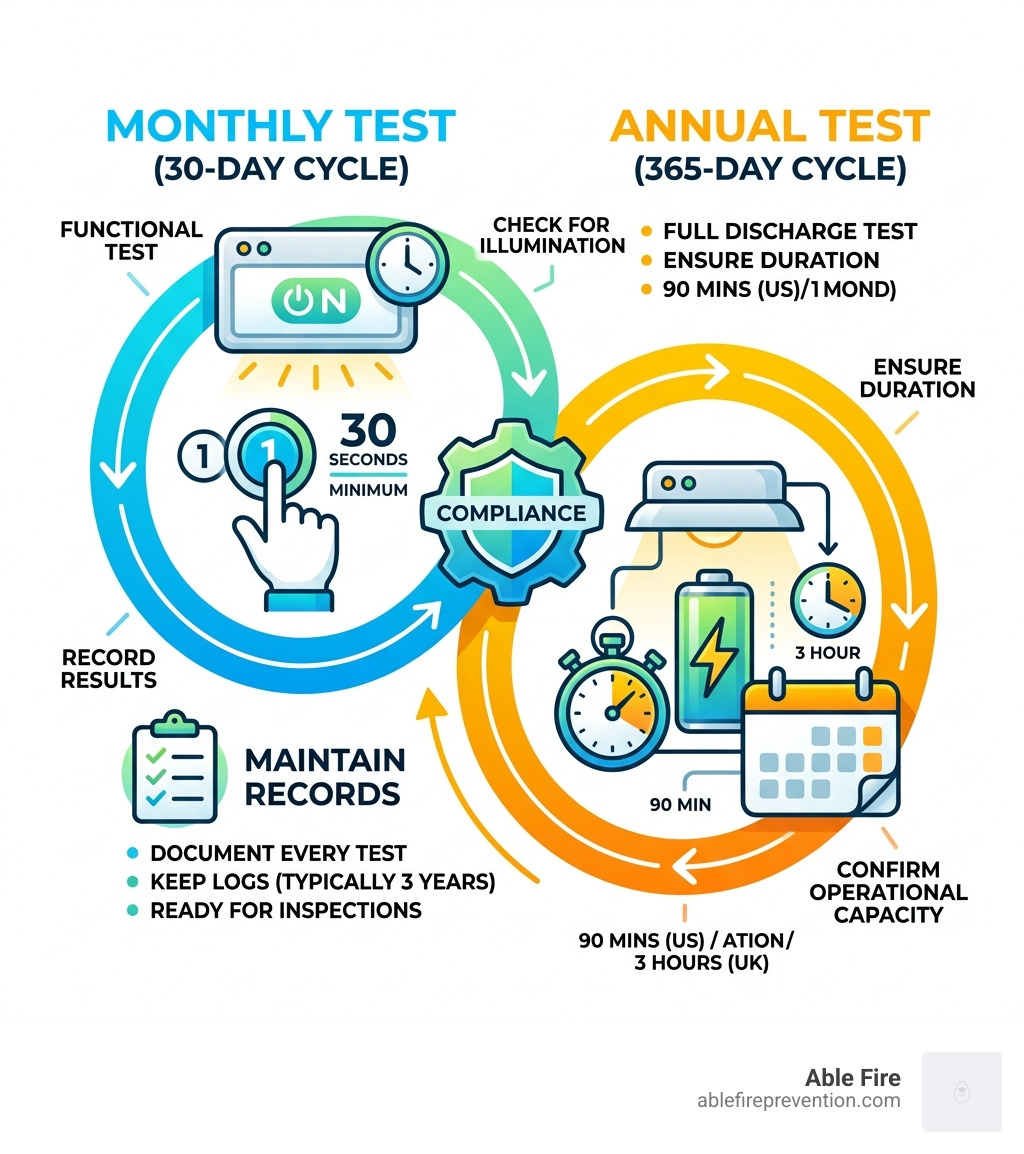
Emergency lighting testing definitions:
Introduction

Emergency lighting is the silent guardian of your facility. When the main power fails during a fire or utility outage, these systems provide the necessary illumination to guide occupants safely to exits. Without regular inspection, a simple battery failure could turn a routine evacuation into a hazardous situation. For facility managers and property owners, understanding the nuances of emergency lighting testing is not just about following the law—it is about ensuring the safety of every person inside the building.
The Importance of Regular Emergency Lighting Testing
In our experience serving New York City, Jacksonville, and the surrounding areas, we have seen how critical these systems are for life safety. The primary goal of emergency lighting testing is to verify that the system will function for a sufficient duration during a crisis. Regulatory bodies like the National Fire Protection Association (NFPA) and the International Fire Code (IFC) mandate specific testing intervals to prevent “surface charge” deceptions.
A battery might show a full charge on a voltmeter or have a glowing green status light, but it could fail within seconds under a real load. Regular testing identifies these weak links before they become life-threatening liabilities. Furthermore, maintaining documented proof of these tests is essential for passing fire marshal inspections and satisfying insurance provider requirements.
| Requirement | NFPA 101 (Life Safety Code) | IFC (International Fire Code) |
|---|---|---|
| Monthly Test | 30-second functional test | 30-second activation test |
| Annual Test | 90-minute duration test | 90-minute power test |
| Illumination | 1 foot-candle initial avg | 1 foot-candle initial avg |
| Records | Written records for inspection | Records per Section 108/110 |
According to standard requirements for emergency lighting equipment, failing to meet these benchmarks can lead to OSHA citations under 29 CFR 1910.37, which requires exit signs to be illuminated to at least 5 foot-candles.
Monthly Emergency Lighting Testing Procedures
The monthly functional test, often called a “flick test” or “flash test,” is a brief check to ensure the lamps activate and the battery is capable of powering them. To perform this, locate the “push-to-test” button on the unit. You must hold this button for at least 30 seconds.
This 30-second duration is critical because it forces the battery to move beyond its initial surface charge. If a battery is defective, it might power the bulb for five seconds and then die; a shorter test would miss this failure. During this time, we recommend you verify that all bulbs are bright, the unit is securely mounted, and the lamp heads are aimed correctly at the path of egress. For more info about testing your emergency lights, you should also check that visual indicators (like the charging light) are functioning as intended.
Annual Emergency Lighting Testing and Battery Duration
Once a year, a more rigorous “duration test” is required. This involves disconnecting the AC power to the emergency lighting circuit to simulate a total blackout. The system must remain illuminated for a minimum of 90 minutes.
In some jurisdictions or specific building types, this requirement is even stricter. For example, while the standard U.S. requirement is 90 minutes, those following certain international standards like BS 5266 in the UK require a full three-hour drain test. In high-density areas, following a NYC specific emergency lighting guide is vital as local codes can be very specific about egress pathway illumination.
During this window, the light must maintain an average of 1 foot-candle of illumination, never dropping below 0.6 foot-candles at the end of the 90 minutes. This ensures that even as the battery nears depletion, the exit path remains visible for a prolonged evacuation or for emergency responders to navigate the building.
Step-by-Step Guide to Performing the Inspection
Performing a proper inspection requires a systematic approach. Whether you are managing a small office in Brooklyn or a large warehouse in Jacksonville, consistency is key. Here is our recommended process for staying compliant with essential requirements for exit sign testing.
- Preparation: Notify occupants if the test will cause significant lighting changes to avoid panic. Ensure you have a ladder, a light meter, and your testing logbook.
- Visual Inspection: Walk the property and check for physical damage, cracked lenses, or leaking batteries. Ensure exit signs are not obstructed by decorations, inventory, or equipment.
- Activation:
- Monthly: Use the manual “push-to-test” button for 30 seconds.
- Annual: Switch off the dedicated circuit breaker. This is the most reliable way to ensure the transfer switch functions correctly and that the unit isn’t just “faking” functionality while still receiving some AC power.
- Observation: Verify the lights activate within 10 seconds of power loss. Monitor the units for the full required duration. If a unit dims significantly before the 90 minutes are up, it is a failure.
- Recording: Log the date, unit ID/location, pass/fail status, and the name of the person performing the test. We suggest keeping these records for at least three years to satisfy fire marshals and insurance auditors.
Troubleshooting Common Failures and Battery Maintenance
The most common failure point in any emergency system is the battery. We often find that units installed and forgotten are the first to fail during an actual outage.
- Battery Types: Most modern units use Lead-Acid or Nickel-Cadmium (NiCd) batteries. Lead-acid batteries typically last 5 to 10 years, while NiCd versions can last up to 15 years. However, environmental factors like high heat in a Florida warehouse or poor ventilation in a New York basement can significantly shorten this lifespan.
- The 5-Year Rule: Many manufacturers recommend a 3-to-5-year replacement cycle for batteries to ensure peak reliability.
- Deep Discharge: If a battery is drained too low (below 80% of its initial voltage), it can suffer permanent damage. This is why it is crucial to ensure units recharge fully (usually taking 24 hours) after an annual test.
- Bulb Issues: Burned-out bulbs are common, especially in older incandescent models. While modern LED units are more reliable and energy-efficient, they still require the same rigorous testing schedule to ensure the internal circuitry remains functional.
If a unit fails a duration test, we recommend replacing the battery immediately. If the unit still fails with a new battery, the charging circuit or the entire fixture may need replacement.
Frequently Asked Questions about Emergency Lighting
How long should emergency lighting batteries last?
Most batteries are designed to last between 3 and 5 years in a commercial environment, though high-quality units may last longer depending on the chemistry (Lead Acid vs. NiCd). They should be replaced immediately if they fail a 90-minute discharge test, regardless of their age.
Can I perform the testing myself?
While building owners can perform monthly 30-second tests, annual 90-minute tests and repairs are best handled by licensed professionals. At Able Fire Prevention, our technicians ensure full compliance with local fire codes and provide the professional documentation that fire marshals look for.
What happens if I fail to keep testing records?
Failure to maintain written logs can result in significant fines from the Fire Marshal or OSHA. More importantly, it could potentially void insurance claims in the event of an injury during a power failure, as you cannot prove the system was maintained according to code.
Are there self-testing units?
Yes, modern “Self-Testing Automated Reporting” (STAR) systems exist. These units perform their own monthly and annual tests and display a status light (usually red) if a failure is detected. Even with these, you still need to perform a monthly visual check to ensure the units aren’t physically damaged and to record the status of the diagnostic lights.
Conclusion
Maintaining a safe environment requires more than just installing equipment; it requires a commitment to consistent maintenance. By following these testing protocols, you ensure that your building remains a safe haven even in the dark.
For property managers and business owners in New York, New Jersey, and Florida, Able Fire Prevention provides the expertise needed to handle these complex inspections. We specialize in ensuring your facility stays up to code with expert, compliant services—from fire alarm monitoring to emergency lighting maintenance.
Our licensed technicians handle professional installation, certified annual testing, and battery replacement, giving you the peace of mind that comes with professional fire safety management. Don’t wait for a blackout to find out your lights don’t work. Contact Able Fire Prevention today to schedule your next inspection and ensure your building is fully protected and compliant.